

In the high-stakes world of 2026 cybersecurity, “good enough” data is a dangerous gamble. As attack surfaces expand into complex multi-cloud environments and AI-driven threats, choosing between Tenable vs Qualys isn’t just a technical preference it’s a strategic pivot for your organization’s survival. ⚡
Whether you are looking for the surgical precision of Tenable’s Nessus engine or the all-in-one consolidated power of the Qualys Cloud Platform, this guide is your definitive roadmap.
We’ve analyzed thousands of data points, real-world deployment scenarios, and the latest 2026 updates to give you the truth behind the marketing hype. 🎯
Are you ready to eliminate blind spots and fortify your network? Let’s dive into the ultimate showdown of vulnerability management titans.
What Is Vulnerability Management and Why It Matters Today? 🛡️
In 2026, the traditional “scan-and-patch” model is officially dead. With over 40,000 new vulnerabilities (CVEs) expected this year alone, security teams are no longer fighting a battle of discovery they are fighting a battle of prioritization.
Vulnerability Management (VM) is the continuous process of identifying, evaluating, and remediating security weaknesses across your entire digital footprint. But why is it the “pulse” of cybersecurity today?

- The 5-Day Window: Research shows that hackers now exploit new vulnerabilities within a median of 5 days, while most organizations still take over 30 days to patch. VM is the only way to close that dangerous “Exploit Gap.” ⏳
- From Assets to Exposures: Modern VM doesn’t just look at servers; it looks at Shadow AI, misconfigured cloud buckets, and identity-based risks. If you can’t see it, you can’t secure it.
- The Cost of Inaction: With the average cost of a breach involving unpatched vulnerabilities soaring to $4.8 million, VM has shifted from a “technical task” to a “Board-level priority.” 📈
- AI vs. AI: Attackers are now using Generative AI to find zero-day flaws instantly. To survive, organizations must use VM tools (like Tenable or Qualys) that leverage AI to predict which bugs will be weaponized next.
Key Takeaway: Vulnerability Management in 2026 isn’t about finding every bug; it’s about finding the 1% of bugs that actually matter to your business continuity and fixing them before an AI-driven botnet does.
According to IBM, vulnerability management is a continuous process of identifying, evaluating, treating, and reporting security weaknesses across IT systems.
What Is Tenable? Key Features & Capabilities
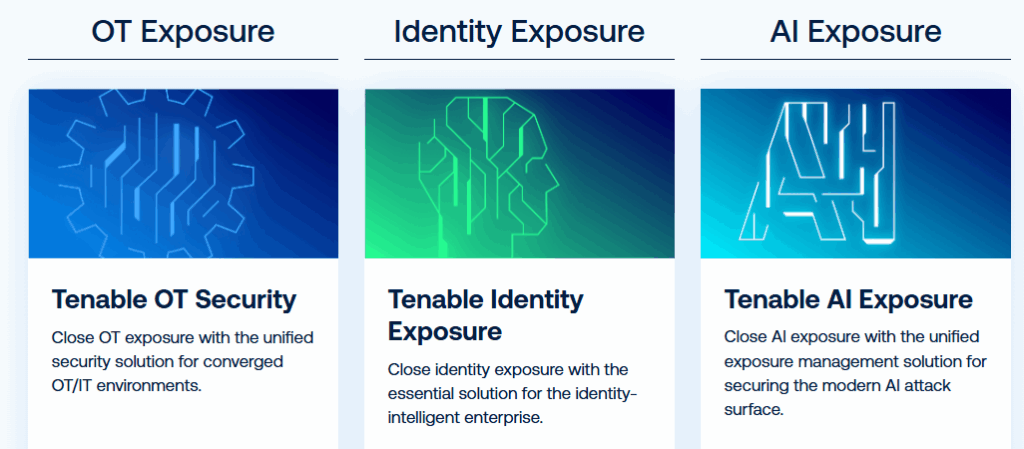
🚀 Meet Tenable One the AI-powered exposure management powerhouse dominating 2026! Evolving from Nessus (born 1998), it unifies visibility across your entire attack surface: IT assets, OT/IoT devices, multi-cloud environments, identities, containers, Kubernetes, and emerging AI workloads. ✅
Breakdown of Key Features:
- Comprehensive Asset Discovery:
Native sensors automatically find unseen assets (cloud, identities, apps) and enrich data from 250+ third-party tools, creating a single inventory with relationship mapping to core business services. - Dynamic Attack Path Mapping:
Visualizes how threats chain across domains (e.g., identity → cloud → OT), helping block critical paths before exploitation. - Predictive Prioritization (ExposureAI):
Scores risks by business impact using VPR, Tenable Research (114K vulnerabilities assessed, 311K+ plugins, 762 disclosures), and NVD data covers high-profile CVEs in under 24 hours. - AI Exposure Management:
Proactively discovers AI applications, plugins, agents, and usage patterns; governs secure adoption while protecting underlying infrastructure. - Automated Remediation:
Orchestrates workflows with prescriptive guidance, SLAs, and integrations (ServiceNow, Jira) to accelerate fixes across hybrid environments. - Advanced Reporting:
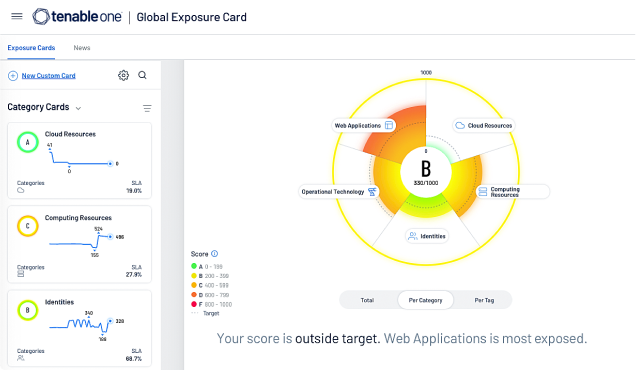
Business-aligned dashboards, generative AI insights, and compliance views for exec communication.
Tenable leads the 2025 Gartner Magic Quadrant for Exposure Assessment Platforms and Forrester Wave for Unified Vulnerability Management—ideal for US enterprises tackling complex, converged ops like manufacturing or supply chains. ⚡
What Is Qualys? Key Features & Capabilities
🚀 Discover Qualys VMDR the cloud-native vulnerability management trailblazer powering rapid risk reduction since 1999! It delivers scalable scanning across hybrid and cloud environments with laser-focused precision for high-velocity teams. ✅
Core Features Explained:
- TruRisk Prioritization:
Combines 25+ threat intel feeds, machine learning, and Six Sigma accuracy (99.99966%) to score vulnerabilities by real-world exploit likelihood cuts noise, focusing on threats with business impact. - Unified Asset Inventory:
Agentless discovery collapses fragmented views into 360° cloud postures, covering IT, containers, and hybrid assets with continuous monitoring. - TotalCloud Suite:
Integrates CSPM, CWPP, and CNAPP for comprehensive cloud security exposes misconfigs, compliance gaps, and workload risks in one platform. - Patch Management & Remediation:
One-click workflows with ITSM integrations (ServiceNow, Jira) achieve 60% faster MTTR (often 4 hours), including automated patching. - Scalable Scanning:
Handles 102K+ CVEs with lightweight agents or agentless options, prepaid IP-based licensing for enterprise growth. - Advanced Analytics:
Custom dashboards, risk-based alerting, and API-driven automation for DevSecOps pipelines.
Qualys excels in Forrester’s UVMP Wave for speed but trails in OT depth perfect for cloud-first US SMBs and enterprises prioritizing quick wins. ⚡
Tenable vs Qualys: Quick Comparison Table
If you want a fast, side-by-side view of how Tenable and Qualys compare, this table gives you instant clarity. It highlights the core differences that actually matter deployment, scanning depth, risk prioritization, and remediation without marketing fluff.
| Feature | Tenable | Qualys |
|---|---|---|
| Platform Type | Cloud + On-prem + Hybrid | 100% Cloud-native |
| Core Focus | Risk-based vulnerability & exposure management | Continuous vulnerability management & remediation |
| Vulnerability Scanner | Nessus (industry-leading) | Cloud agents & scanners |
| Asset Discovery | Strong, but scan-driven | Continuous & passive discovery |
| Risk Scoring | VPR (Vulnerability Priority Rating) | TruRisk scoring |
| Cloud & Hybrid Support | Very strong (IT, cloud, OT, identities) | Strong (IT, cloud, endpoints) |
| Patch Management | Limited / add-on dependent | Built-in patching & workflows |
| Ease of Deployment | Moderate (more setup flexibility) | Very easy (cloud-first) |
| Best For | Large enterprises, complex environments | Cloud-first teams, fast execution |
| Pricing Approach | Enterprise-focused, tiered | Modular, usage-based |
What This Table Tells You Quickly
- Choose Tenable if you need deep risk context, advanced analytics, and broad attack-surface coverage across complex environments.
- Choose Qualys if you want simplicity, continuous visibility, and integrated remediation with minimal infrastructure overhead.
This table sets the foundation. In the next sections, we’ll break down each critical area in detail so you can see why these differences matter in real-world security operations.
Vulnerability Scanning & Asset Discovery Comparison 🔍
Vulnerability scanning and asset discovery are the foundation of any vulnerability management program. If a tool fails to identify all your assets or misses critical vulnerabilities your security strategy is already at risk ⚠️. This is where Tenable and Qualys take two clearly different approaches.
How Tenable Handles Scanning & Discovery 🛠️
Tenable relies on its well-known Nessus scanning engine, which delivers deep and highly accurate vulnerability detection. Tenable primarily uses active scanning across networks, servers, cloud workloads, containers, and OT environments to uncover vulnerabilities and misconfigurations.
Strengths of Tenable scanning:
- 🔎 In-depth vulnerability detection
- 🏢 Strong fit for complex and regulated environments
- 🧠 Detailed technical insights for security teams
Limitations to consider:
- ⏱️ Asset discovery is mostly scan-based, not continuous
- 🌐 Less real-time visibility in fast-changing cloud environments
How Qualys Handles Scanning & Discovery ☁️
Qualys follows a cloud-native, continuous discovery model. It combines cloud scanners, lightweight agents, and passive techniques to detect assets in real time even unmanaged or short-lived systems.
Strengths of Qualys scanning:
- ⚡ Continuous, real-time asset discovery
- 🌍 Excellent visibility in dynamic cloud and hybrid setups
- 🧩 Lightweight agents with minimal system impact
Limitations to consider:
- 🧪 Slightly less granular vulnerability depth for advanced analysis
- 📌 Greater dependency on agent deployment in some cases
Final Takeaway 🚦
- Choose Tenable if you prioritize deep scanning accuracy and detailed risk insights.
- Choose Qualys if you need real-time visibility and continuous asset discovery in fast-moving environments.
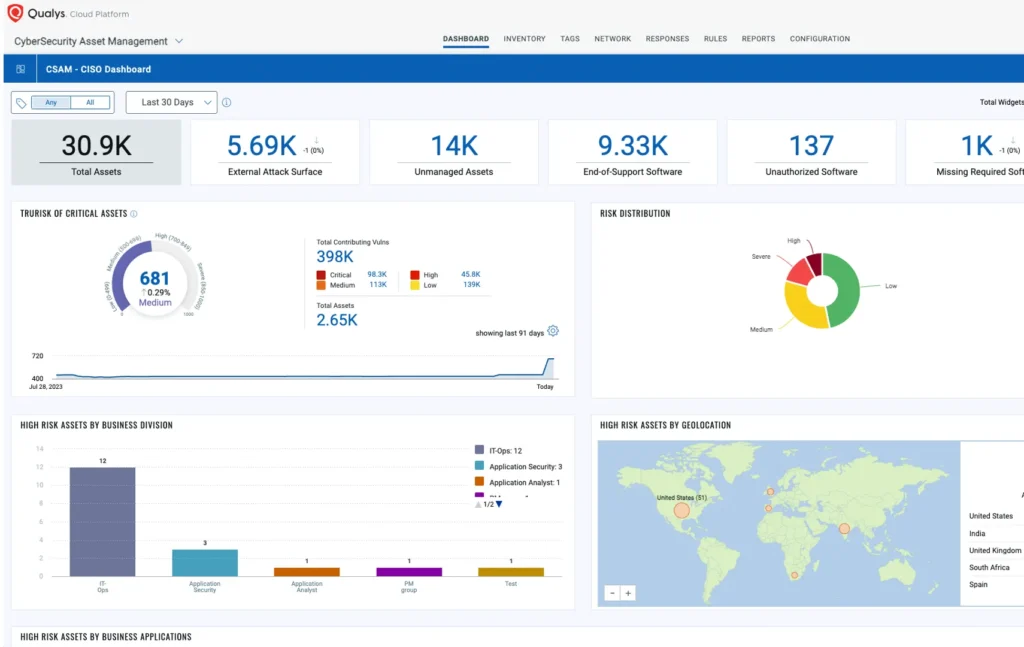
Both tools are powerful but the right choice depends on how dynamic your infrastructure really is 🔐.
Risk Prioritization, Threat Intelligence, and Accuracy 🎯
This is where the real battle is fought. Finding vulns is easy; knowing which to fix first is hard.
| Aspect | Tenable | Qualys |
|---|---|---|
| Prioritization Engine | Vulnerability Priority Rating (VPR): A predictive, ML-driven score (1-10) that changes based on active threat intel. | TruRisk Score: A financial/risk-oriented score (0-1000) blending 25+ threat feeds, asset value, and exploitability. |
| Threat Intelligence | Powered by Tenable Research, one of the world’s top teams, discovering 300+ CVEs themselves. | Aggregates data from 25+ external threat intelligence feeds, including its own research. |
| Claimed Accuracy | Industry-leading breadth with 311,000+ plugins. | Publishes Six Sigma (99.99966%) accuracy claims for detection. |
| Business Context | Tenable Lumin: Provides peer benchmarking and translates tech risk to business impact. | Business context is embedded via asset tagging and reporting, but less focus on external benchmarking. |
🏆 Winner for Prioritization: Tenable, by a nose. While Qualys’ TruRisk is excellent for operational workflow, Tenable’s combination of predictive VPR and business-centric Lumin provides a more compelling story for both technical teams and executives. Its proprietary research also adds a layer of depth.
Many modern vulnerability management platforms rely on real-world threat intelligence frameworks like the MITRE ATT&CK framework to understand how vulnerabilities are exploited in active cyber attacks.
Patch Management, Remediation, and Automation Capabilities 🤖
Detection is worthless without remediation. Here’s the biggest differentiator:
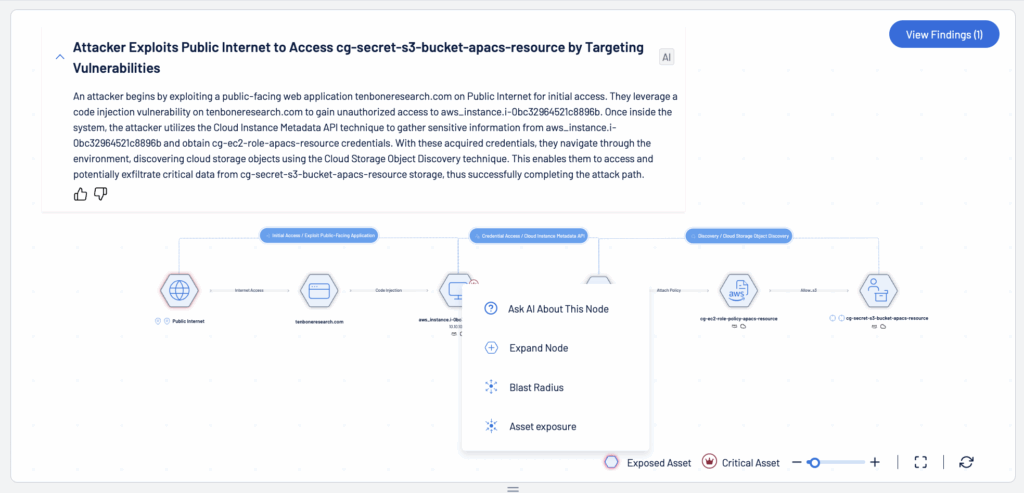
- Qualys: Holds the knockout advantage. Its integrated Patch Management means you can often go from detection to deployed patch within the same console, without needing SCCM or Intune. This is a massive time-saver.
- Tenable: Takes the orchestrator approach. It provides superb, prescriptive guidance and integrates with your existing patch tools (WSUS, SCCM, Intune, etc.) to kick off workflows. It doesn’t replace your patch system but makes it smarter.
- Automation & Integration: Both have strong APIs and automation. Qualys is often praised for its deeper, “no-code” workflow builder and superior ServiceNow integration. Tenable boasts a vast partner ecosystem (250+ integrations) for flexibility.
🏆 Winner for Remediation: Qualys. For organizations wanting an “all-in-one” find-and-fix machine, Qualys’ native patching is a decisive feature. Tenable is better suited for shops that want to optimize their existing, mature patch infrastructure.
Pricing Comparison: Tenable vs Qualys (Plans, Cost & Value)
🚀 Unlock the real cost showdown Tenable’s flexible power vs Qualys’ scalable affordability! Both are quote-based (no fixed public prices), scaling by assets/IPs, but value hinges on your environment size and needs in 2026. ✅
Tenable Pricing Highlights (From official plans):
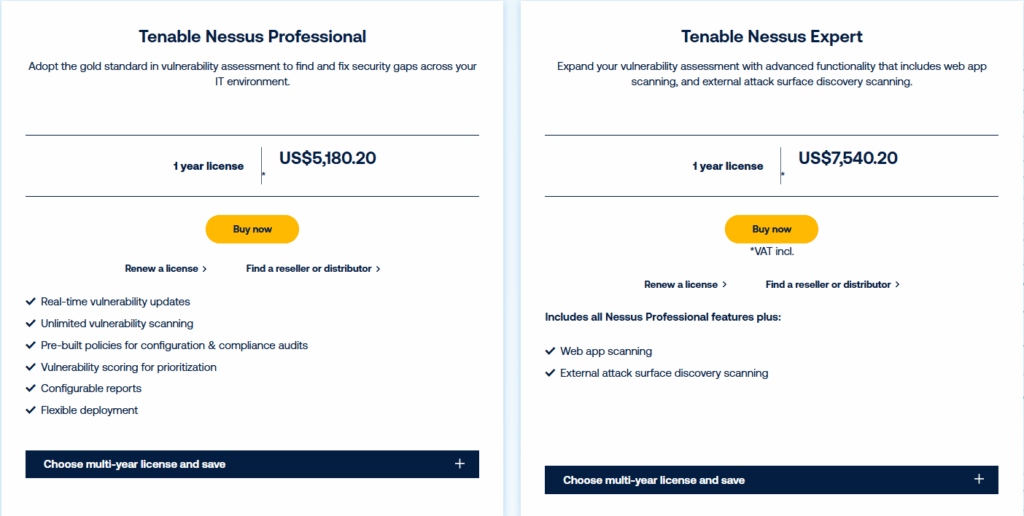
- Nessus Professional: $5,820/year (1 license)—basic scanning, policy audits.
- Nessus Expert: $8,920/year (1 license)—adds web app scanning, external discovery.
- Tenable One Enterprise: Custom (~$50K+ for 44K assets) full exposure mgmt, AI/OT.
Flexible asset-based model includes support; higher entry for broad coverage.
Before making your final decision, review any limited-time Tenable promo deal that may apply to your organization.
Qualys Pricing Highlights:
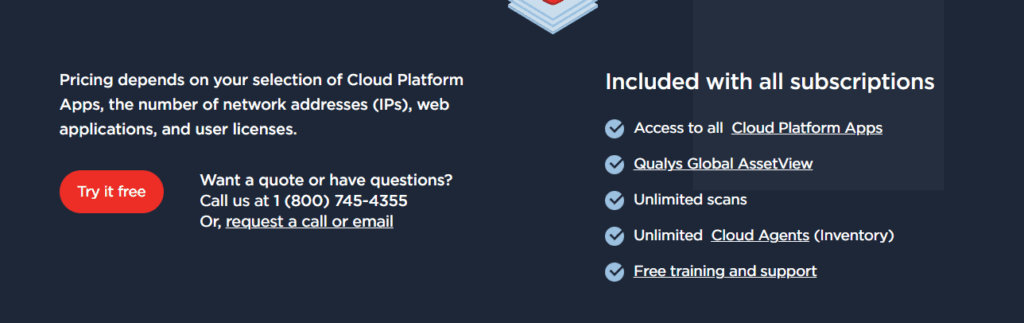
- IP-based subscriptions: ~$2-5K per 100 IPs/year (prepaid discounts).
- All plans include unlimited scans, Cloud Agents (inventory), Global AssetView, and access to apps like VMDR/TruRisk.
- Add-ons for patching/users; scales “extra small to extra large” with free training.
Value Comparison Table:
| Factor | Tenable | Qualys | Winner |
|---|---|---|---|
| Entry Cost | $5K (Nessus Pro+) | $2K/100 IPs | Qualys |
| Scaling Model | Asset-based, hybrid | IP-based, volume discounts | Tie |
| What’s included | Plugins, research, integrations | Unlimited scans/agents | Tenable |
| Enterprise ROI | Broad coverage, premium | Faster MTTR for cloud | Depends |
| Free Trial/Support | Demos included | Free trial/training | Tie |
Tenable delivers superior value for complex, OT-heavy US enterprises (e.g., +ShipChain security); Qualys wins budget-conscious cloud scaling. Request quotes for exacts! ⚡
Pros, Cons, and Final Verdict: Which One Should You Choose? 🏁
At this point, you’ve seen how Tenable and Qualys compare across scanning, risk prioritization, remediation, and pricing. Now let’s simplify everything into a clear, decision-ready summary so you can confidently choose the tool that fits your security needs 🔐.
✅ Tenable – Pros & Cons
Tenable Pros
- ✓ Industry-leading vulnerability scanning with Nessus 🔍
- ✓ Strong threat-driven risk prioritization (VPR) 🎯
- ✓ Excellent for complex, regulated, and hybrid environments 🏢
- ✓ Deep technical insights for security teams 📊
Tenable Cons
- ✕ Higher cost for advanced enterprise features 💸
- ✕ Limited native patch management ⚙️
- ✕ Can feel complex for smaller or lean teams 🧠
✅ Qualys – Pros & Cons
Qualys Pros
- ✓ Fully cloud-native and easy to deploy ☁️
- ✓ Built-in patching, remediation, and automation 🔄
- ✓ Continuous asset discovery and real-time visibility ⚡
- ✓ Reduces tool sprawl with an all-in-one platform 🧩
Qualys Cons
- ✕ Less granular vulnerability depth for advanced analysts 🧪
- ✕ Pricing is less transparent (quote-based) 📉
- ✕ Customization can feel limited in highly complex environments ⚙️
🥇 FINAL VERDICT: THE 2026 DECISION
Choose TENABLE ONE if: You are a large, complex organization with a hybrid (IT+OT) environment. You need to speak the language of business risk to your board and want a predictive, proactive view of how attackers might navigate your network. You value industry benchmarking and are building a mature exposure management program.
Choose QUALYS TRURISK PLATFORM if: You are a cloud-forward or cloud-only company. Your top priority is closing vulnerabilities fast with minimal tool-switching, thanks to integrated patching. You want a single metric (TruRisk) to drive daily team actions and have deep investments in ServiceNow or similar IT workflow tools.
Bottom Line: There is no “loser” here. You are choosing between two elite, but philosophically different, champions. Tenable is the strategic visionary. Qualys is the operational efficiency expert. Your organization’s specific blend of assets, workflows, and strategic goals will point clearly to one path over the other.
Next Step: Request a live PoC (Proof of Concept). Test each platform with a slice of your real environment for 30 days. The right choice will become obvious when you see it working on your data.
“RELATED ARTICLES”
- OT Security in Supply Chains: Why Industrial Systems Are a Hidden Risk
- What Is Cyber Exposure Management & Why Businesses Need It
FAQs ❓
1. Is Tenable better than Qualys for small businesses?
Tenable’s Nessus Professional is often more affordable for small teams, but Qualys VMDR offers more “all-in-one” value if you don’t have a separate patching tool.
2. Can Qualys replace my Patch Management software?
Yes, in many cases. Qualys has a robust native patch management module that can replace tools like WSUS or Ivanti for many common applications.
3. Does Tenable scan cloud environments?
Yes, Tenable.cs and Tenable One offer deep visibility into AWS, Azure, and Google Cloud, specifically focusing on misconfigurations and container security.
4. Which tool is better for PCI Compliance?
Both are “Approved Scanning Vendors” (ASV), but Qualys is often praised for having a slightly more streamlined workflow for generating PCI-ready reports.